



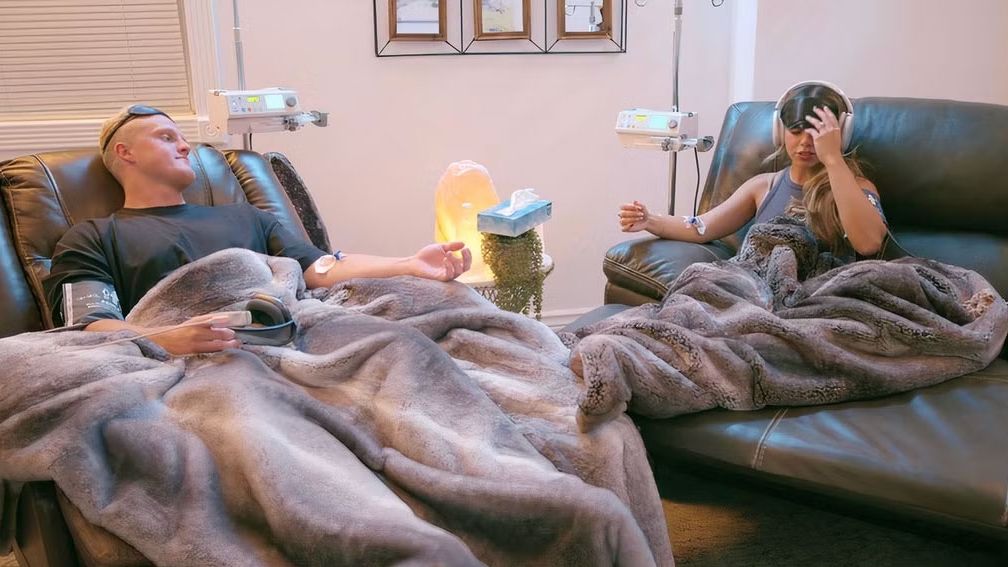
At higher doses, ketamine knocks people out, and increases paranoia and suicidal thoughts; at lower microdoses, it’s said to make you feel detached and dial down negative thought patterns.
This is because of the way it affects the brain. Unlike conventional antidepressants, which work by boosting the activity of brain chemicals such as serotonin, ketamine appears to impact glutamate, a neurotransmitter thought to play a role in regulating mood. Put simply, it claims to help break the cycle of negative thoughts.
“Ketamine puts the brakes on, and often ideas about suicide and death seem to melt away,” Dr Rupert McShane, a consultant psychiatrist and associate professor at Oxford University, who has led a ketamine trial in the city, tells GLAMOUR. “At its simplest, ketamine helps to rebuild and strengthen connections. However, like conventional antidepressants, most people who are seriously unwell need to keep taking it for years.”
Is ketamine therapy safe?
The jury is still out on whether ketamine therapy is safe.
It has undergone some clinical trials on both sides of the Atlantic. In 2018, a study published by the U.S National Library of Medicine concluded that a single intravenous dose of ketamine had rapid antidepressant effects.
In the UK, doctors did a small study trialling ketamine to treat depression between 2009 and 2014. “Since then we have provided a clinical service to about 400 patients some of whom have continued to take it for 10 years,” says Dr McShane. “About half think it is worth continuing to pay for it.”
But Dr Fritz Swart, a specialist in neuro-rehabilitation in South Africa, who has experience in addiction medicine and treatment of mental health disorders, is more cautious.
“Ketamine is generally reserved for treatment-resistant depression (TRD) – in other words, depression that doesn’t respond to an adequate period of using antidepressant medication,” says Dr Swart. “The studies that have been done are relatively small and not robust enough to conclude that this treatment is safe. There are gaps in our knowledge of this drug and uncertainty remains about optimal dosing and duration of treatment. I personally would not consider this, until more research is done.”
What is certain, however, is that there are serious risks associated with taking ketamine without supervision. For one, there is a risk of dependency. “Ketamine is probably about as addictive as vodka,” Dr McShane says. “It all depends how much and how often you take it. Some patients need to increase the dose they take to get the same effect so this is why it needs medical supervision.”
Dr Swart also raises alarm bells over the risk of psychosis, “which can also lead to suicidal, agitated and aggressive behaviour,” he notes. “It is therefore contra-indicated in people suffering from mental disorders such as Schizophrenia and severe mood disorders, such as depression or mania with secondary psychosis.”
Likewise, the Oxford Health NHS Trust notes on its website that “occasionally people experience a worsening in their depressive symptoms and suicidality, which persists for up to two weeks after taking ketamine.”
So, is ketamine therapy likely to become the next big thing in mental health and more widely accessible if you’re having marriage problems like Jen and Zac? Possibly, but until there is more extensive research and those gaps in knowledge are filled, its future, for now, remains unclear.
For more from Fiona Embleton, GLAMOUR’s Associate Beauty Director, follow her on @fiembleton.
Sign up to our newsletter for more daily content straight to your inbox.



Follow